Blog/Body & Energy
Why ADHD makes sleep so hard (and what gently works)
The Finnela team
9 min read
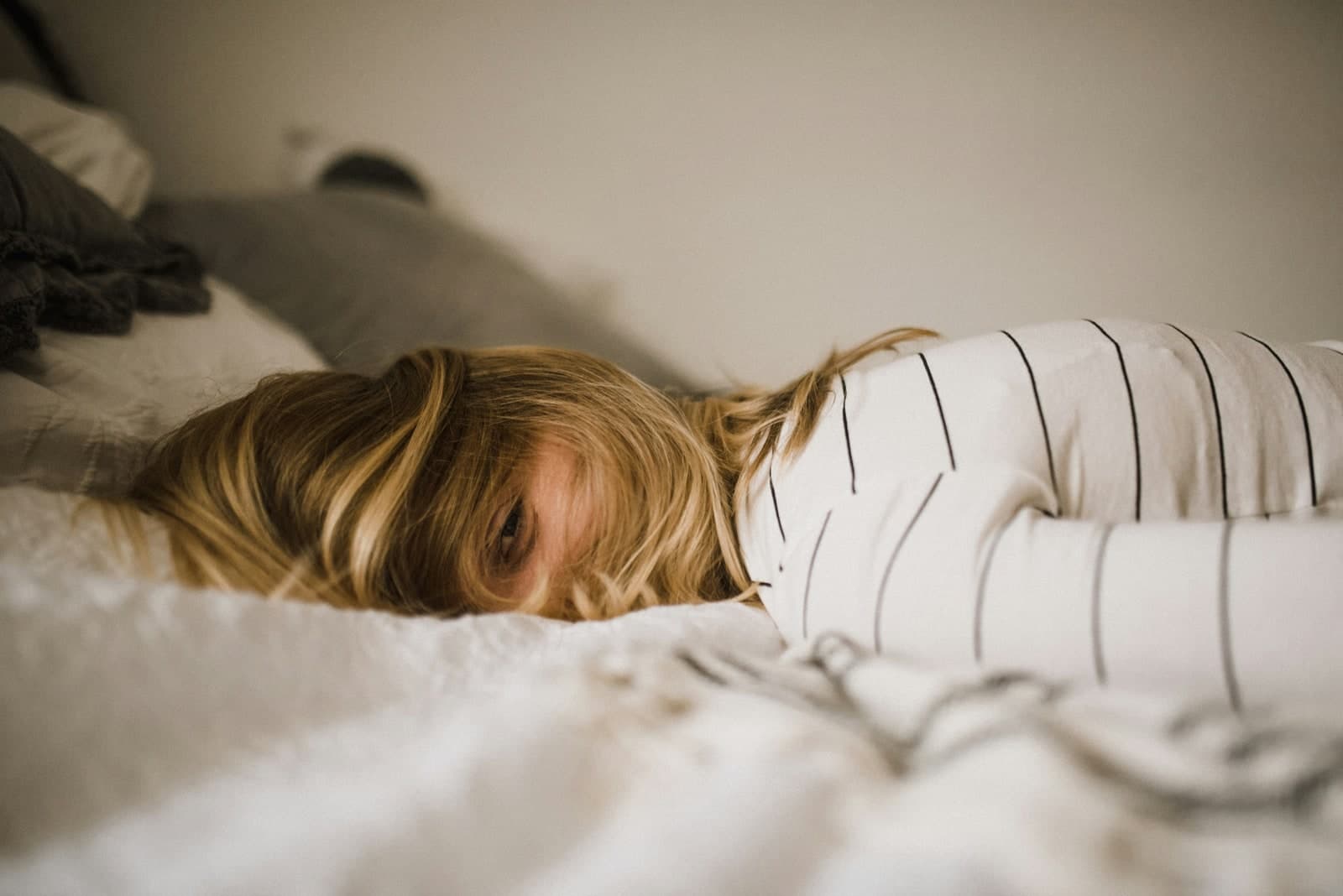
You've flipped the pillow over again, looking for the cool side. The body is settled: heavy, still, one leg out from under the sheet. The body is there.
Upstairs, no. Upstairs everything is still switched on: the email you didn't send, the look someone gave you on Sunday and, out of nowhere, the name of a teacher from school.
Tomorrow, the same again. And on top of that, you brought this on yourself.
There's no bedtime here
What follows describes a mechanism, and a mechanism is nobody's portrait. Recognizing yourself here doesn't mean you have ADHD.
And there's no bedtime for you here. That isn't an article's business.
There's an hour when the body thinks night has fallen, and in ADHD it comes later
Every body carries a clock that decides when night begins on the inside. You don't read that off a phone: you read it in saliva, from a hormone the body releases when its own darkness arrives.
Coogan and McGowan went through everything published on that clock in ADHD in 2017: 62 studies and more than four thousand four hundred people with ADHD. The result keeps repeating: the inside hour comes out shifted later.
Plainly: it isn't that anyone goes to bed late. It's that at that hour, on the inside, it's still late afternoon.
The honest part: these are snapshots of a single moment, and they don't say whether ADHD moves the clock, whether the clock moves ADHD, or whether both come from the same place. The review mixes children and adults, and there's no figure for how many people this happens to: those groups come out of specialist clinics, not off the street.
That isn't sleeping badly: it's sleeping little, with the night cut off at both ends
With insomnia, you want to sleep and can't. This is something else: the sleep works, what's moved is the hour. Someone with this, if they're left to sleep when the body asks for it, sleeps plenty.
The trouble starts when the outside clock asks for an hour the inside one doesn't have. In people whose clock is shifted, the night gets cut at the start by one and at the end by the other, and the subtraction piles up from Monday to Friday. That has been described in clinics for years. Who it happens to and who it doesn't is exactly what nobody has ever counted.
Nesbitt described it that way in 2018: this gets looked at over weeks and in a clinic, not from one stray night in the small hours.
The honest part: it doesn't even hold true always among people who already have that diagnosis. Murray and colleagues measured it in 2017 in diagnosed patients, and in a large share of them no misalignment showed up at all.
And there's a stretch, right before the usual hour, when falling asleep is hardest
The two or three hours before the usual hour of falling asleep are the worst moment of the twenty-four for getting to sleep. It isn't that tiredness is missing: it's the clock itself giving its strongest alerting signal of the day, right before it drops it all at once.
It was tested in a lab, with light and dark chopped into pieces around the clock for a day and a half. Lavie described it in 1986: in that window people didn't fall asleep, not when they tried and not when they resisted. And then, all at once, what they called the sleep gate opened.
The reference guideline in sleep medicine, the one from Auger and colleagues in 2015, doesn't come down either way on setting schedules as a treatment: there isn't enough evidence.
The honest part, and it's a big one: that experiment was done with men only. And when it was repeated in 2024, the window showed up sharply in adolescents and barely moved at all in adults in their thirties and forties. None of those studies was done with people who have ADHD. None. That the window shifts later along with the clock is a piece of reasoning, not a finding, and nobody has measured it. On light, which is what moves that clock best, there's already another article on this blog.
What does hold up is smaller, and it helps just as much: you've spent years getting into bed earlier and it hasn't worked, and that isn't a measure of anyone's willingness. Why it doesn't work is exactly what hasn't been measured.
The next day it isn't the reasoning that goes: it's the holding on
When sleep is taken away in a lab, not everything breaks in the same way. Lim and Dinges pulled together what had been published in 2010: what sinks the most is holding attention on something boring for a long stretch, with lapses of a few seconds that multiply. Reasoning, and what's already known, barely move.
Sleeping little doesn't make anyone stupid. It makes them intermittent. And how much of a life lived in pieces is explained by sleep, nobody has measured that yet.
The honest part: that's sleep taken away all at once, in healthy people, with tasks on a screen. It looks nothing like sleeping an hour less every day for years, which is the thing nobody has studied.
And what switches off first isn't the energy, it's the wanting
Palmer and colleagues pulled together fifty years of experiments in 2024 in which sleep was taken away on purpose: one hundred and fifty-four studies and almost six thousand people.
What shows up again and again isn't "she gets grumpy". It's that the good goes down: enjoyment, cheerfulness, appetite for things. And anxiety goes up. Distress and depressive symptoms, on the other hand, come out mixed. And it showed up with very little: an extra hour or two awake is enough.
After a short night, the first thing to go isn't stamina. It's that nothing appeals. And from the inside that doesn't read as "I slept badly". It reads as "how dull I've become".
The honest part: healthy people, without ADHD, with an average age in the twenties. Who feels it more and who feels it less is still unexplored, and they say so themselves.
What happens in those small hours and never gets shown
Saying "I'm going to bed now" out loud and, twenty minutes later, still standing in the hallway without quite knowing what for.
Three alarms set ten minutes apart, and no memory of turning any of them off.
The show you've already seen, again, because that way there's nothing to decide.
What gets recommended for sleep has less ground under it than it looks
And before anything else there's the usual list: screens out, a light dinner, a cool room, getting up at the same time. That list has been circulating for decades and has mostly been studied in people who sleep normally. In people with ADHD, much of it has never been tested. That doesn't mean it doesn't help. It means whoever repeats it doesn't know, and that years of failing it is not a fact about anyone.
In the first meta-analysis of sleep in adults with ADHD, the one by Díaz-Román, Mitchell and Cortese in 2018, what people report separates the two groups clearly and the one-night lab test finds no difference at all. The worst conclusion often gets drawn from that: it must just be you. The authors conclude the opposite: that sleep is something to ask about, always.
The therapy recommended for insomnia is also offered to people with ADHD. Cullen and colleagues pulled together what exists in ADHD and autism in 2025: eight studies, nearly all with children and with men. On adults with ADHD there was only one, small and with no comparison group. From that you can't conclude that it works or that it doesn't: you can conclude that nobody has answered that question yet. Nothing you might be offered is ruled out here, and if something is already under way that helps you sleep, that isn't touched here for better or worse: that's a conversation with whoever is treating you.
And the promise that fixing sleep fixes everything else has been tested too. In a randomized trial with adults who have ADHD and sleep problems, the one by van der Ham and colleagues in 2026, adding sleep treatment to the usual ADHD treatment did not reduce symptoms more than the usual treatment already did. What did improve more was fatigue. And fatigue is not a consolation prize.
The honest part, and it's the one most often muddled: "not studied" is not "doesn't work". It means nobody has checked it properly. That trial was small and nobody was blinded.
What gets told in a sleep appointment
A shifted schedule, or sleep apnea, are told apart in a clinic and with weeks ahead of you. Sleep apnea is when breathing stops during the night without you knowing, and it gets looked at with a test, not by eye. Your family doctor's is a fine place to start, and what helps to bring isn't a label: what time you fall asleep with no alarm, how many nights a week the same thing happens, and since when.
What's left standing
That the inside hour comes out later in ADHD is measured, and it repeats. That the sleep gate shifts along with it is sensible reasoning that nobody has checked. And the price paid the next day has been studied in people without ADHD.
That's enough to stop telling yourself one thing: the hour at which sleep opens isn't chosen at night, with ADHD or without it. What's underneath in any given case, an article doesn't settle that.
This is educational support, a complement to medical care and never a substitute for therapy or treatment. Nobody is diagnosed here.
And if the last few months of small hours came down on you while you were reading, putting them in order is what the Map does. It's free, it takes a few minutes, and it doesn't hand back a schedule: it hands your own tangle back to you, in order.
And one more thing, set apart from everything above. If you find yourself thinking you don't want to be here, that doesn't wait for an appointment: tell someone today, a professional or a crisis or emergency service in your country. And if something is getting away from you, with drink, with food, with whatever it is, that's one to take to a professional too. It isn't that there's no room here for how you're feeling: it's that they can help you better there than here. No talking around it, and nothing to be ashamed of.
Where this comes from
- Coogan and McGowan (2017). ADHD Attention Deficit and Hyperactivity Disorders. A systematic review that mixes children and adults.
- Nesbitt (2018). Journal of Thoracic Disease. A clinical review.
- Murray et al. (2017). Sleep.
- Lavie (1986). Electroencephalography and Clinical Neurophysiology.
- Monterastelli et al. (2024). Frontiers in Sleep.
- Auger et al. (2015). Journal of Clinical Sleep Medicine. A clinical practice guideline.
- Lim and Dinges (2010). Psychological Bulletin.
- Palmer et al. (2024). Psychological Bulletin.
- Díaz-Román, Mitchell and Cortese (2018). Neuroscience & Biobehavioral Reviews.
- Cullen et al. (2025). Journal of Sleep Research.
- Van der Ham et al. (2026). Journal of Attention Disorders.
If this sounds like you, your Map puts it in order.